
- New evaluation of digital marketplaces finds gaps in safety policies and practices for baby products, but some companies made changes immediately
- CR calls on all shopping platforms to take key steps that will protect consumers’ safety
- CR offers tips to parents shopping online for baby products
YONKERS, NY—Consumer Reports (CR) today released a report evaluating four major digital marketplaces—Amazon, Walmart, Target, and Temu—that analyzed over 100 baby product listings for safety. CR’s assessment found gaps in marketplace policies and practices that may result in items for sale that are prohibited by law or by corporate policy. CR also released its marketplace product safety playbook today.
CR engaged directly with platforms to inform them about our findings, and secured multiple safety improvements that benefit consumers. In particular, two industry leaders, Temu and Amazon, committed to changes that improve safety information, disclosures, and recall transparency.
“This is an example of how Consumer Reports does more than report on a problem—we work with companies to fix it,” said Oriene Shin, manager of safety advocacy at Consumer Reports. “By engaging directly with major global platforms, we’re helping achieve systemic safety improvements for consumers. Amazon and Temu’s actions show the critical role these companies can play in setting strong policies that help people make safer and more informed shopping decisions for themselves and their families.”
CR’s Marketplace Safety by Design report follows a groundbreaking 2024 CR white paper, which first identified how current U.S. product liability and safety laws have failed to keep pace with the evolving e-commerce landscape. A nationally representative Consumer Reports survey from October 2025 shows that 84% of U.S. consumers feel online retailers should be responsible for the safety of third-party products sold on their platforms by third-party sellers, just as walk-in stores are responsible for the safety of the products they sell.
“With more marketplaces hosting third-party sellers, it’s crucial that the industry has clear guidance to help keep consumers safe,” said Johnny Mathias, director of corporate strategy and engagement at Consumer Reports. “Parents have enough to worry about when shopping for children’s products, they shouldn’t have to second guess about safety. We developed a playbook to guide companies so consumers have the access to the same critical information online as they would in a brick-and-mortar store. Prioritizing marketplace safety is not just the right thing to do, it is a sound business decision to build trust and retain long-term customers.”
Key Evaluation Findings:
CR’s evaluation focused on three high-risk children’s product categories: full-size cribs, pacifiers, and children’s pajamas. Each of these products are required to meet mandatory federal safety standards and can present an unacceptable risk of harm to children if they are not designed or labeled properly. View CR’s evaluation scorecard of Amazon, Target, Temu, and Walmart.
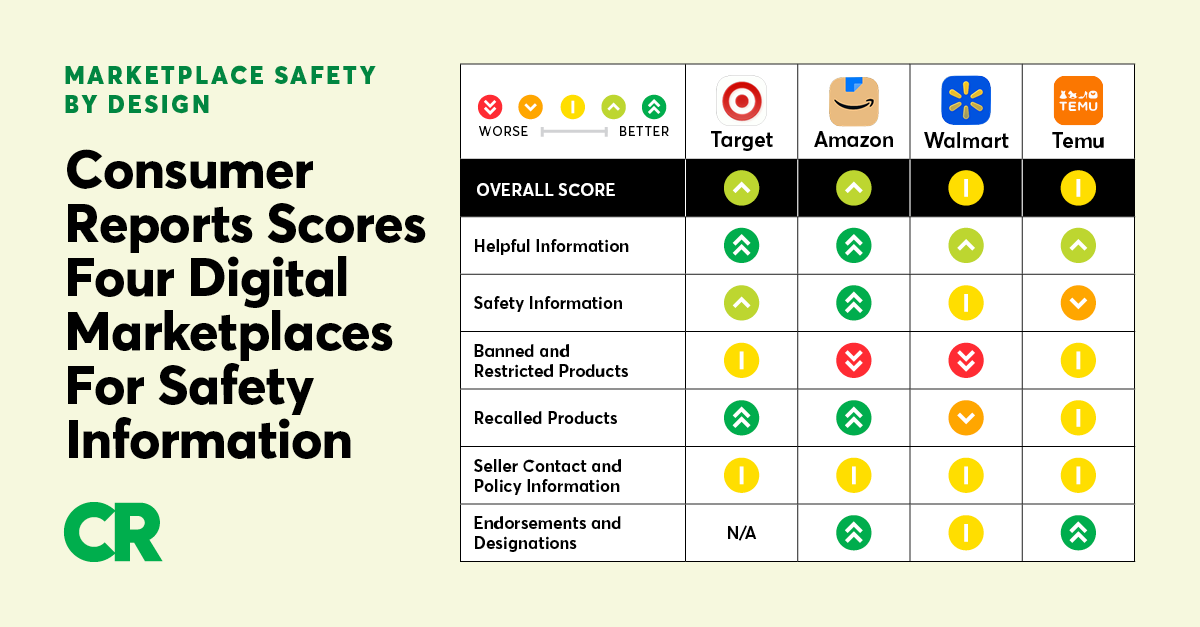
- Safety Benchmarks: Each platform excelled in a different area of our evaluation, suggesting that CR has offered achievable recommendations to create safer digital marketplaces. When accounting for every aspect of the evaluation, Amazon and Target performed better overall than Temu and Walmart.
- Banned and Restricted Goods: CR found federally banned padded crib bumpers for sale on Amazon and Temu, and hazardous water beads—restricted by corporate policy—on Walmart and Amazon. Amazon, Temu, and Walmart removed these products following CR outreach. Target was the only marketplace where no banned or restricted children’s products were found.
- Missing Critical Information: Some listings lacked critical general product and safety information—such as mandatory age ranges, weight limits, and safety warnings—leaving parents without the information they need to ensure a product is safe for their child.
- “CPSIA Certified” Listings: Several listings claimed to be “CPSIA Certified”. While certain certifications are required under the law to demonstrate compliance with the provisions of the Consumer Product Safety Improvement Act of 2008 (CPSIA), there is no such thing as “CPSIA certified” or a “CPSIA certification.”
Systemic Changes for Marketplace Safety:
Amazon and Temu adopted the following CR-recommended improvements:
- Amazon updated pacifier listing standards to include mandatory strangulation warnings required by law on all pacifier packages. For children’s pajamas, Amazon added improved sizing information and a safety page on their flammability risk.
- Temu launched a new, more accessible “Product Safety Alerts and Recalls” center, as well as personalized recall notices based on purchase history. Temu also created a prohibited products list accessible to consumers via both the app and browser. Temu now requires merchants to conduct BPA testing for pacifiers and submit verification documents, and enhanced its safety disclosures for crib and pacifier listings.
- Amazon and Temu both took down unsafe product listings that CR found, and have committed to making additional changes, shared in the report, that are expected to be implemented by the end of March 2026.
CR shared evaluation findings with all four companies weeks prior to publication. Amazon and Temu engaged most directly with CR and committed to several concrete changes. Target outlined general commitments, but did not engage in depth with CR at that stage. Walmart acknowledged receipt of CR’s findings and recommendations but did not commit to any action.
Digital Marketplace Product Safety Recommendations:
With third-party sales projected to reach 59% of global e-commerce by 2027, CR is making short-term and long-term recommendations for industry-wide adoption. These measures require companies to integrate safety into their digital marketplaces through standardized safety information, visual guardrails, recall transparency, and increased seller accountability to protect consumers from hazardous products and ensure they can make fully informed purchasing choices.
These recommendations align with CR’s Digital Marketplace Product Safety Framework, which is informed by CR’s product testing, consumer research, direct engagement with platforms, and product safety expertise.
Consumer Tips: How to Shop Safely:
For more information on the evaluation and practical tips on how to navigate digital marketplaces safely, read our CR story here.
***
Media Contact: Emily Akpan, emily.akpan@consumer.org